Getting Ready To Welcome Your Puppy Home
What do you need for a new puppy?
Hello and thank you for joining our waiting list, welcome to the first of a series of emails that I hope will be helpful to you in the very exciting countdown to bringing your beautiful little puppy home.
We are often asked by new families ‘what will I need to have before my puppy comes home’?
This is the basic list of items and where you can find them
PP40 Crate - you can find these on Marketplace or Gumtree, they will often have had one use and will be up to a third of the new price. Just give them a clean with a solution of 17ml bleach and 500ml cold water, this will kill any unsafe viruses. If you choose a new crate, clean with the same solution to be safe.
Crate Bedding - old cotton sheets and doona covers are perfect - don’t use synthetics in the crate as it will make your puppy uncomfortably hot.
Food and Water Bowls - I recommend good quality stainless steel as they are so easy to keep clean, any pet supply shop will have them. The water bowl needs to hold at least one litre.
Lead and Collar - we don’t recommend using harnesses unless they are for securing your puppy for travel. Using a harness when leading a puppy will quickly teach it to pull on the lead.
Your puppy will go with a high quality Blackdog Wear collar, in the colour it was assigned at birth and it will have an ID tag that is hand engraved with your puppies name and your phone number.
We stock and sell Blackdog Wear leads and collars as they have become our product of choice for our own dogs. You are able to purchase these from us at puppy pick up if you wish.
Food - our puppies are eating a raw diet and chewing raw bones when they leave us, we recommend feeding raw and have our own recipe book that includes meals that are easy to prepare and freeze in advance. We sell packs of the supplements that we use.
If you are unable to commit to making food at home, there are some really good pre-made raw foods such as Lyka, Pet Mince Direct or Leading Raw that can be ordered.
Soft Beds - the sky is the limit here! We love Snooza Futons for general day beds.
Toys - just make sure they are durable!
There is so much fun to be had preparing for your little puppy to come home, puppy shopping is the BEST!
From Kerrie and Shaun and all the Beardies of Merindah Farm
Raw bones are the best natural teeth cleaner - try your local butcher and get the bones cut to between tennis ball and softball size pieces and keep a stock in your freezer. We get our bones from Echo Valley Farm, if you are in Brisbane you can order bones online from them and delivery is weekly into Brisbane.
A small upright freezer may be a good addition, so you can store a supply of your dogs food.
Some of our families have purchased a mincer to make their dogs food. If you do that, check and make sure it can mince chicken wings with the bone in and whole carrots.
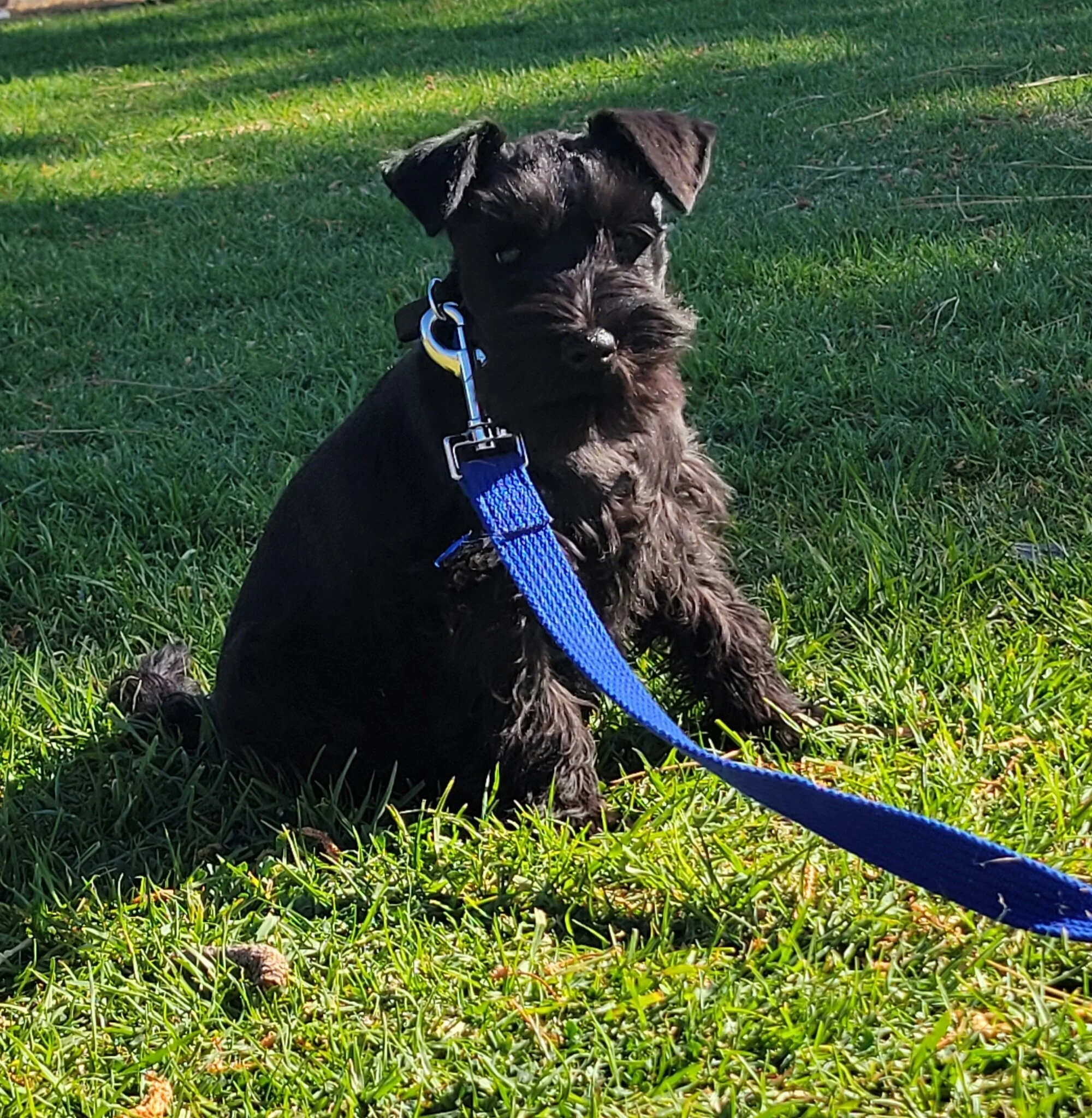
Puppy development stages and behaviours.
All puppies go through developmental stages from birth, right through to their senior years, these are our observations of those stages.
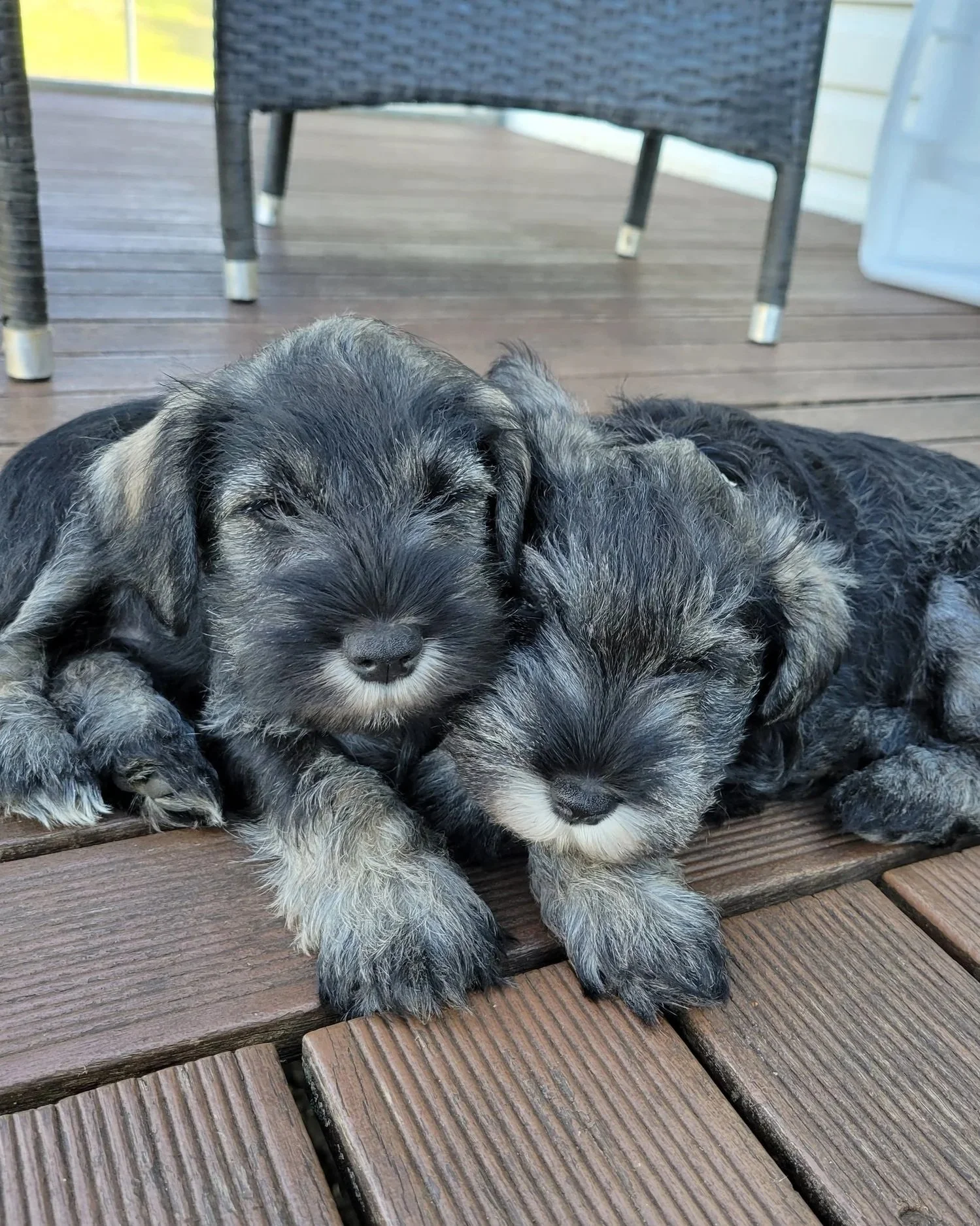
From birth to 9 weeks there are so many amazing developmental stages that we are so blessed to see.
Puppies are born with their eyes and ears sealed shut, so they rely on smelling mum (specifically the milk bar) and sensing warmth. Within 24 hours of birth, puppies are able to find and lie on (or under) the heat pad that we place in their whelping box, if their mum is out of the box for a short while. Warmth is super important for neonates, as this keeps their digestion functioning well.
At 10 days their eyes open but they are still blue so we don’t expose them to harsh light or sunlight. At around 2 weeks their ear canals open and they quickly start noticing when we walk into the room or make some sound.
At around 3 ½ to 4 weeks they start to really get up on their feet to walk around and they start playing with each other which is so jolly cute!
Around 5 weeks we start to offer them solids and milk, but they are still taking most of their nutrition from mum. Meals can get messy! Luckily mums love to clean up after their puppies.
By 5 ½ weeks they are telling us they need to start going outside to the toilet and by 6 weeks they are spending all day outside and coming back in at night to sleep.
At 7 ½ weeks they start transitioning into individual crates to sleep at night, as we start to build their independence from their mum and from each other. Mum is properly starting to wean them by this time and she spends less and less time with them during the day, of her own choice.
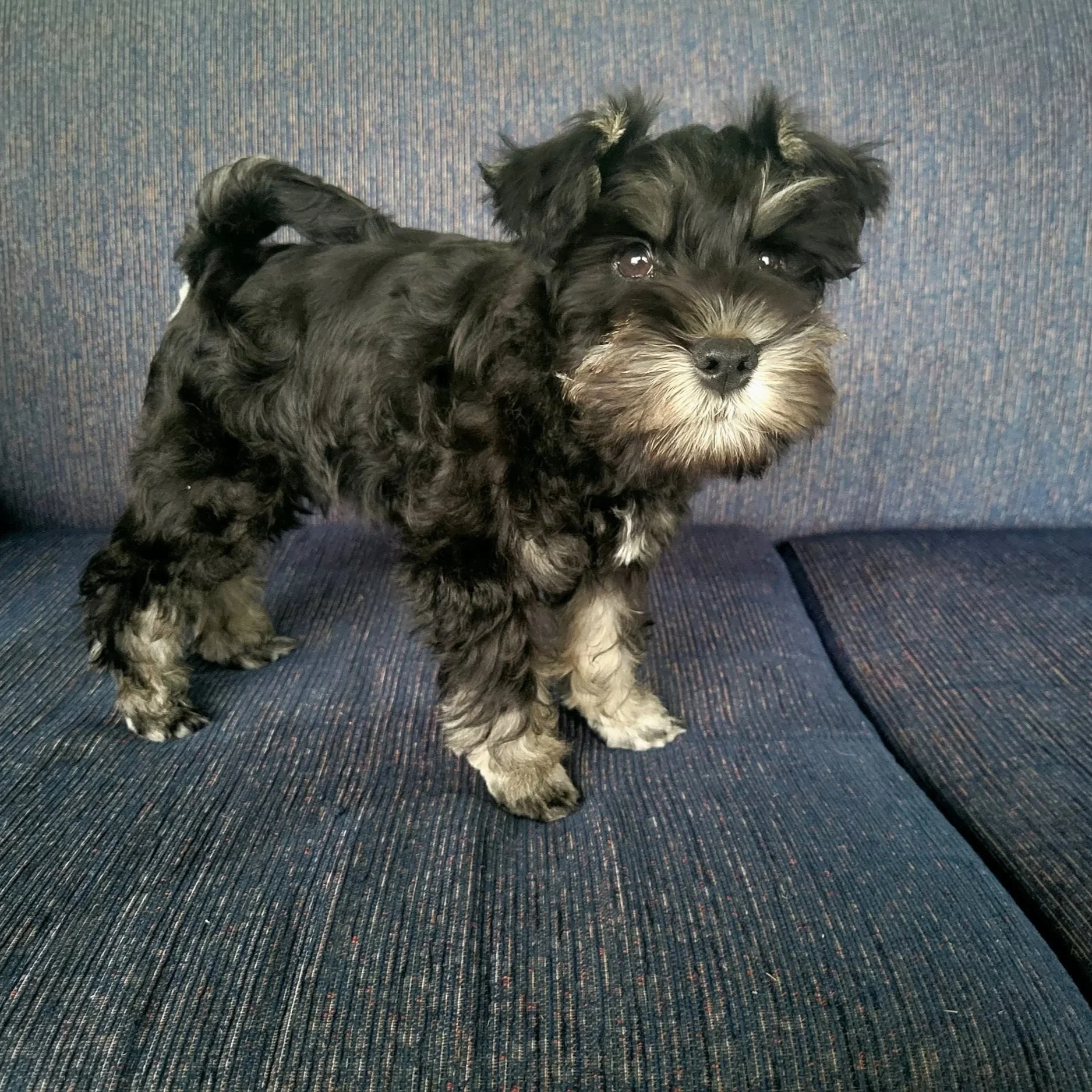
Between 14 and 16 weeks they start transitioning from puppy to early adolescence and this is when their behaviours start to really change. This is when they start exploring the world with very bold behaviour and with their teeth. Often they will become a lot more vocal and want to chew or drag things around, becoming destructive, feisty and noisy. This is the hard work stage as this is where they need a lot of guidance around acceptable and unacceptable behaviours so they can grow to be good adult doggie citizens.
At around 51/2 to 6 months they transition into later adolescence and particularly if their early training has been consistent and effective, this is where they start to settle down and do a lot less pushy behaviors. This stage lasts until they are around 2 years old.
From 2 years, young dogs transition into adulthood where they start to settle down a lot more and not be looking to push boundaries nearly so much (dogs never really stop trying, it’s a natural thing for them to do). When the early training has been in place, this is where the humans start to really reap the rewards as their young dog settles into sound mature behaviours and becomes the reliable companion that we all want to share our life with.
From 12 onwards, mature dogs will start to transition into their senior years and will require more care and attention as their bodies age and slow down. These years are precious as our faithful old friends still want to enjoy their world, just at a slower pace - they are the gentle heartbeat at our feet.
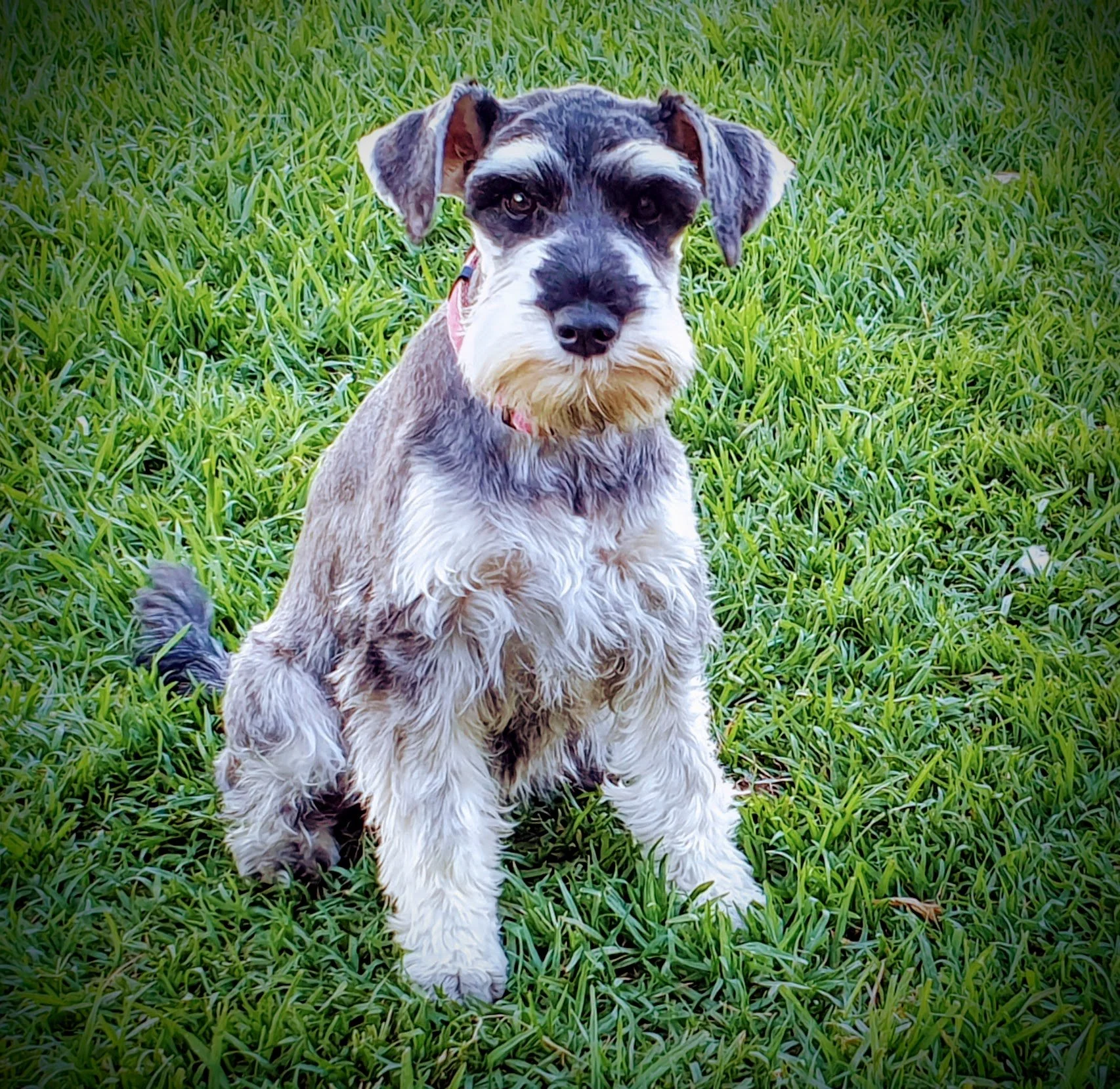
Overall, our dog spends the majority of it's life in the adult stage and it's later senior years. Often people do forget just how much hard work goes into bringing a puppy home and raising it to be that well mannered dog that we remember so well.
From Kerrie and Shaun and all the Beardies of Merindah Farm
What tablets and medication should I have
Hi to everyone on our contact list.
Today I’m going to give a few recommendations of medications to have on hand before your puppy comes home.
Parasite Control
There are 2 separate parasite control regimes you should follow with your puppy / dog, this is because the medication that controls heartworm and paralysis ticks, does not control the hydatid tapeworm. It is very important to control this parasite as it is transferable to humans and can cause cysts in various organs.
We use and recommend Canine All Wormer which you can purchase online, for general worm parasite control. This is a 3 monthly dosage and requires that your puppy be weighed to ensure the correct dosage and the dosage should always be rounded up. This is important as underdosing can lead to resistance of the parasites to the medication.
For example, a tablet does a 10kg dog, so if your puppy weighs 5.5kg, you will round up to ¾ of a tablet.
For prevention of Heartworm and Paralysis ticks, our vet recommends monthly Nexguard Spectra which you can purchase at places like Petbarn. These tablets are in a weight range, for this reason I recommend buying packs of 3 at a time as your puppy will grow and increase in weight. The 3.6kg to 7.5kg is a good range to start with.
Peptosyl and a 5ml syringe is very valuable to have in your doggy first aide kit. At the first sign of any gastro such as vomiting or particularly diarrhea, administer according to the weight of your dog. Murphy’s Law - dogs will start having gastro at no earlier than 3pm on a Saturday afternoon when all vets have switched to after hours rates. Being able to quickly treat the first signs may mean avoiding a trip to the vet and will save your dog a lot of discomfort. Dogs hate the taste, you need to hold their muzzle and administer the dosage down one side of the mouth, preferably down low between their teeth and hold the muzzle upwards so they swallow the whole dose.
Vytrate Sachets - if your dog gets a bad bout of gastro they will quickly become dehydrated. Vytrate is an animal electrolyte that you give in place of water to aid their recovery. I start giving this alongside the Peptosyl and give free access to it for at least 24hrs from the start of treatment.
This does not replace the need to see a vet if symptoms persist.
Digital Thermometer clearly marked Dog and kept in the dog first aide kit (so no-one in the family is tempted to use it on themselves).
If your dog appears off colour a quick way to know there is an issue is by taking its temperature which is done rectally. Put a small amount of lubricant such as olive oil on the end of the thermometer before inserting. It is very useful information to give a vet or vet nurse.
A temperature of over 39.2 is considered a fever.
I hope this is able to help you be prepared for bringing your little puppy home.
With kind regards,
Kerrie and Shaun and all the Schnauzies of Merindah Farm
Nutrition
We feed a fully raw diet and have our own recipe book to assist our puppy families to continue this, which is available to our families here - Merindah Farm Raw Food Recipe Book. We sell the supplements that we use as packs that will give about 20 weeks of feeding. We do this as a service for our puppy families only, as people were having difficulty sourcing the supplements that we use.
Dried kibble is not a healthy option to choose regularly for your dog and we definitely don’t recommend starting a young dog on dried food any earlier than 7 months of age. Dried food sucks the moisture out of the dog’s gut while being digested, causing a dehydrating effect which makes the dog need to drink a lot more water than normal to deal with that. This has a direct impact on your young dog’s need to pee and poo much more frequently and will affect their ability to go through the night without toileting.
With puppies we are often supplementing with lactose free fresh cows milk (not long-life milk), as an additional source of calcium, protein and fat while they are growing. Normally we are stopping this at around 3 months of age.
Raw meaty bones are an essential part of your puppies life. Raw bones are the gold standard for cleaning a dog’s teeth, our oldest dogs still have bright white teeth because they are having bones at least three times a week.
A good guide for size is, ensure the bone is no smaller than the size of your dog’s head and it won’t choke. Don’t panic if your dog chews off bits of bone and swallows them, the dog’s digestive enzymes are designed to deal with raw food and bits of bone.
Chicken wings may be fed from after the pup turns 6 months of age, they can easiy crunch them up by then with no risk of choking. A note here, chicken bones are not teeth cleaning bones, they are a food only.
Never ever feed cooked bones!
If your vet is horrified by the idea of raw feeding and gets the vapours about giving dogs raw bones, they are ignoring what dogs were originally designed to eat. I would recommend finding a vet who does not sell any dog food in their clinic. Holistic vets are far more accepting of natural diets for dogs, if you can find one of them you will be doing your dog so many ‘life choice’ favours.
Our wonderful vet encourages raw feeding and regular bones and he has quote to us, for every 2 cases he sees of a dog having an issue from chewing a bone, he is seeing 100 cases of poor dental hygiene requiring cleaning or extractions.
Your dog doesn’t get to make decisions about what it eats, food that will affect it for the duration of it’s life. Please make informed decisions on behalf of your dog and advocate for their long term good health.
Knick Knack Paddy Whack, Give a Dog a Bone!
From Kerrie and Shaun and the Bearded Doorbells!
Toilet Training including in Apartments
Your Merindah Farm puppy or young dog comes addicted to toileting outside on the grass and if you follow what we recommend at your puppy pick up, you will have minimal to no accidents in the house.
If your puppy does happen to wee or poo in the house, this is my favourite way to deal with that behavior. I take my shoe off my foot, then give myself a mighty tap on the head with it and tell myself to be far more diligent with watching my puppies cues and to set an alarm every 2 hours to take them outside. Never, ever chastise your puppy because when it comes toilet trained, the act of toileting in the house would have been out of desperation and someone not reading their cues quickly enough.
Our puppies are quite able to spend good amounts of time outside during the day, if you set this up from the day you bring them home this will remain their ‘normal’ and will give them quick easy access to their outside toileting area.
In apartments, toileting is very different to our situation and needs some specific retraining to be successful. The toilets that are sold as ready to use with inbuilt grass, are far too small for our puppies and they will think it’s bad behaviour to use them.
We have found that buying a tarp and 2 x 2m2 bits of turf from bunnings, and a pet enclosure that will just fit around that grass, is the smallest area that can be started with. Lay the tarp down on your balcony, put the 2 bits of turf side by side and then set up the enclosure panels around the grass so the puppy has no choice but to be on the grass.
When picking your puppy up from us, ensure we give you a couple of bits of poo in a plastic bag, you will need to put this on your grass as the ‘it’s ok it’s the toilet’ ice breaker for the pup. Then as needed, put the pup on the grass and wait until you see it toilet. Immediately say ‘Toilet’ as the cue word and then praise profusely and once finished, give it a little treat. Your pup will quickly form an association with it’s action, the cue word and that it’s highly desirable to do (from the praise and treat)
Over the ensuing few weeks, you can reduce the size of the grass and enclosure, until it is the size of the actual doggie toilet that you have purchased. Keep up the routine of setting and alarm and taking your pup to the toilet so it develops a rock solid toileting habit in your apartment.
This is an app that has been developed by one of our clever puppy families to assist with the ongoing toilet training of your puppy.
https://www.puddleandpile.com/
Yours in Puddles and Piles outside of the home!
Kerrie and Shaun and the Bearded Ones
Understanding How Puppies and Dogs Think
This topic is always up for so much contention but this is my observation of living with, training and loving dogs for close to 50 years. I’ve no formal qualifications but I have always had a strong passion to be humble and observant and to learn, both from others who I see being successful working with dogs but most importantly, the dogs themselves.
Puppies and dogs are opportunists, they will take advantage of situations if they can. By the nature of doing this it doesn’t mean they are sneaky or naughty animals, they are just following theri instincts and being dogs. Dogs also think in terms of leadership - who is the leader? If they feel lack of leadership, they will try to step up and become the leader.
We humans do grossly overhumanise dogs but the beauty of dogs is that they are not at all like us. We have no capacity to love and forgive like a dog does. How dogs think and communicate also needs to be understood and respected, we cannot make them think like us, they are far too instinctive for that, and why should we want to change that about them?
Dogs don’t live by a democracy ie equality and freedom of speech and when we try to include them in our world in that way, boy do they find that confusing.
This confusion can quickly end up looking like reactive behaviors such as barking a lot or growling and guarding items or people in the home. It shows up as over stimulation which looks like excitement fed by red jelly beans and caffeine and with Mini Schnauzers, will sound like ear piercing and brain hurting amounts of barking and shrieking. This is where people find themselves uttering, he/she isn’t aggressive, they won’t hurt you - multiple times to every person that is met on an outing.
It can also lead to the dog becoming more assertive as it tries small challenges for leadership that the humans don’t see happening, if unchecked, this can lead to full blown aggression that involves the dog’s teeth and may draw blood from the human.
When we humans are taken out of the equation, if dogs live together as a group they form a pack. The pack always has a leader and then successively the dogs under the leader go down as 2nd in charge, 3rd in charge etc right down to the last dog or dogs, that are often classed as the ‘under-dogs’.
Dogs gain their leadership by being the most assertive and by being very clear about their communication and assertiveness with the rest of the pack. If the pack suspects their leader is failing (being inconsistent or weak), the leadership will immediately be challenged and if the old leader can’t defend it’s position, a new leader will emerge and all the dog’s show the new leader their attention.
This is why when a dog lives with it’s human pack, if the humans in the pack don’t show clear and assertive leadership and communication, the dog will get quickly confused and will start trying to fill the void that it sees, itself.
We humans need to be ready from the moment our puppy comes into our life, to be clear and consistent and assertive enough that the pup responds as though it clearly understands the message. Puppies are far more robust and pushy that we ever imagine them to be. For us to be fair, we need to have our ‘house rules’ clear from the start and know how to follow through with clear communication that the pup understands, when standing by our house rules.
Our commitment to our puppy families is to provide training and support to enable our families to communicate clearly and assertively and with complete fairness, to guide these beautiful little puppies on how to live in our world so that they have calm and polite manners and are a delight to have live in our homes, and to take out into our world on doggie adventures.
Naughty or poorly behaved dogs get left at home and often can start to affect the way people socialise in their own home ie ‘we can’t have people over because the dog won’t stop barking and jumping on our guests, who don’t like it’.
We breed our pups to go out into the world and have awesome lives and adventures of all types, well behaved pups and dogs get these wonderful opportunities.
Training pups and dogs is hard work and it’s ongoing, they are not a programmable robot, they are a living being capable of making decisions at any stage of their life. Sometimes the training gets messy, can feel uncomfortable and sometimes can get properly frustrating but believe me, the hard work you put in learning how to communicate with your dog, pays off 10 fold when you can take your dog anywhere with reliable good behavior.
Let us help you to achieve these things.
Yours in letting dogs be dogs, and guiding them appropriately in our world.
Kerrie and Shaun and the beach going, puppachino drinking, hospital visiting, happy and social Mini Schnauzers of Merindah